


While I was working on a traditional vyshyvanka blouse for my granddaughter Gloria, I rediscovered my love for Ukrainian embroidery. Early on in that process, I decided that I needed to make an embroidered blouse for myself. As this notion coalesced, I envisioned my blouse as a more contemporary Ukrainian vyshyvanka blouse. A blouse that combined a more modern style with strong roots in the Ukrainian tradition.
But then I got busy with other things, and this idea of a me-made-for-me vyshyvanka blouse went by the wayside. That is until I saw there was to be an Embellishment Contest on Sewing Pattern Review, a great online sewing community I belong to. These contests are not just fun, they are a driving force. Entering a contest creates deadlines and keeps me on track to actually finish a project. I decided to enter. I had one month to make myself a contemporary vyshyvanka blouse embellished with hand embroidery.
Found Inspiration
I was in the basement not too long ago, fishing through a tub of old table linens, and I bumped into a cache of items that came from my mother’s home. There, amidst an assortment of embroidered napkins and doilies, I found my first vyshyvanka – the blouse my mother made for me as a child. Over sixty years old, the colors were still as vibrant as when it was new. I ran my fingers across the cross stitching and the hand crocheted trim, admiring the embroidery, but mostly admiring my mom for finding time for handcraft in her busy, hard-working life.


I was about six years old when my mother made this vyshyvanka blouse. She was a busy woman who not only worked a taxing job outside of the home, but also was responsible for all of the traditional mom duties and volunteering at church and the Ukrainian Hall. You didn’t really see my mom sitting still very often. But Mama would embroider during her long bus/el train commute from Chicago’s far south side to her job as a night-shift janitor in a downtown office building. I remember my mom showing me her work as it progressed and being so excited for the finished product. This experience definitely sparked my love for handcraft and the desire to make beautiful things.

It was ALL the colors!!
All of the little girls in our Ukrainian community had a vyshyvanka to wear for special occasions. And though all vyshyvankas are unique works, I knew from the get-go that mine was even more special than that. Most of my peers had lovely vyshsyvankas sewn in red and black patterns. The red/black color combination is very traditional. My vyshyvanka was different. My blouse was being embroidered with bright, multi-colored roses!
I so loved my colorful vyshyvanka and I was excited every time I could wear it. To pay homage to my very busy mama who took the time and effort to make my vyshyvanka so special, I decided my new vyshyvanka blouse would also be embroidered with a floral pattern in multi-colored thread.

Blending Ukrainian Tradition with a Modern Silhouette
In my mind’s eye I envisioned a less traditional, more contemporary version of a vyshyvanka blouse. A version to mix traditional elements, like balloon sleeves, with modern elements, like a mandarin collar, buttons and rouleau button loops.
For the embroidery design itself, I definitely wanted to go floral, versus strong bands of geometric designs which are common in Ukrainian tradition. Not only are floral motifs organic and fluid, they are very forgiving if/when you make a counting error. I planned for a light scattering of floral sprays on the fronts and sleeves, with one lone floral spray centered on the back.
Handcrafted Design
For this blouse I wanted to create an abstracted motif featuring barvinok (periwinkle vine). In the Ukrainian culture, floral symbology is important, rich and varied. Certain flowers holding specific meanings and significance. Barvinok can survive harsh winters. Barvinok thrives in difficult growing conditions, even when it is planted in the shade. Periwinkle is a symbol of endurance, and it is a vibrant symbol of the Ukrainian people’s inherent strength and resilience. Since barvinok symbolizes so many positive virtues, my blouse will be imbued with oodles of positive Uky mojo 🙂
Using Adobe Illustrator and some existing designs from my library as reference, I created original embroidery motifs for my blouse. These motifs are focused on a favored blue/purple/green color combo, with glints of red and yellow to brighten up the whole effect.

Picking and Prepping the Perfect Materials for an Heirloom Vyshyvanka Blouse
When making an heirloom piece of clothing, I want to use a high quality, natural fabric. For this blouse I pictured something lightweight… almost sheer. Like a handkerchief linen or a fine cotton voile. Though delicate in look, this fabric needed to have the woven stability to support the cross stitching. As fabric weight and structure was my main concern, I really needed to feel this fabric to evaluate it properly. Off to the fabric stores!!
My first stop was Fishman Fabrics. Fishman’s is the best resource in Chicago for high quality fabrics, with a large selection of fine linen from Ireland and Belgium and nice cotton wovens from Italy. I walked through the doors with fingers crossed and I was not disappointed. When I saw this 100% linen windowpane weave I was hooked. This fabric is kind of sheer and definitely light feeling. Plus, I’m entranced by the notion of embroidering organic floral motifs on a fabric with checkered pattern. I scooped up three yards.
A thorough prewashing process always helps to minimize wrinkles in linen. Before cutting, I spent a couple of days prewashing my windowpane linen per the Sandra Betzina linen prep method.


Preferred Tools and Notions
Waste canvas — As my ground fabric was not an evenweave (like I used for Gloria’s vyshyvanka) I would need to use waste canvas to accomplish the embroidery. To save the time and tedium of drawing out the waste canvas threads once my embroidery was complete, I decided to use water soluble waste canvas on this project. Water soluble waste canvas — sometimes referred to as water soluble aida — is essentially thin flexible sheets of water soluble glue that are perforated to accommodate even cross stitching. It is basted on and used exactly like standard starched waste canvas. Once the embroidery is finished, instead of soaking and drawing out each warp and weft canvas thread, strand-by-strand, water soluble waste canvas is simply soaked off. A real time saver!
Embroidery floss —To create a neat and efficient embroidery process, I prepared my floss for a two-thread embroidery using a no-knot method. My floss prep process is detailed a previous post on vyshyvanka sewing.
Embroidery needles — Though I used blunt pointed tapestry needles when embroidering on evenweave fabric, I think a sharp point needle works better when embroidery with waste canvas. Best Royal No.6 needles are super sharp and a comfortable length that suits my embroidery technique. This Japanese brand is hard to find in the USA, so I make a habit of picking them up at a mercerie when I am traveling in Spain or France.

Embroidered buttons — I wanted my buttons to be embellished with a bit of embroidery. I have made my own covered buttons in the past using the kits available online, and they turn out… okay. An heirloom piece like the one I envisioned deserved better than okay. I went whole hog and sent away for custom covered buttons. I embroidered a scrap of my linen with little multi-colored “flowers”, spread about 2″ apart. Then I sent it off to custom button producer with instruction to center the embroidered flower on each button. The entire process took two weeks.
Other necessary supplies – When I’m sewing a multi-colored pattern I pre-thread multiple needles with the various colors. It’s a good idea to have a pincushion at the ready for keeping pre-threaded needles organized. I have two pairs of sharp embroidery snips at hand to accomplish all the thread changes. For handwork of all sorts, I like to wear a pair of neck lights. NOTE: A complete Materials Resource List is at the end of this blogpost
Crafting a More Modern Vyshyvanka Silhouette
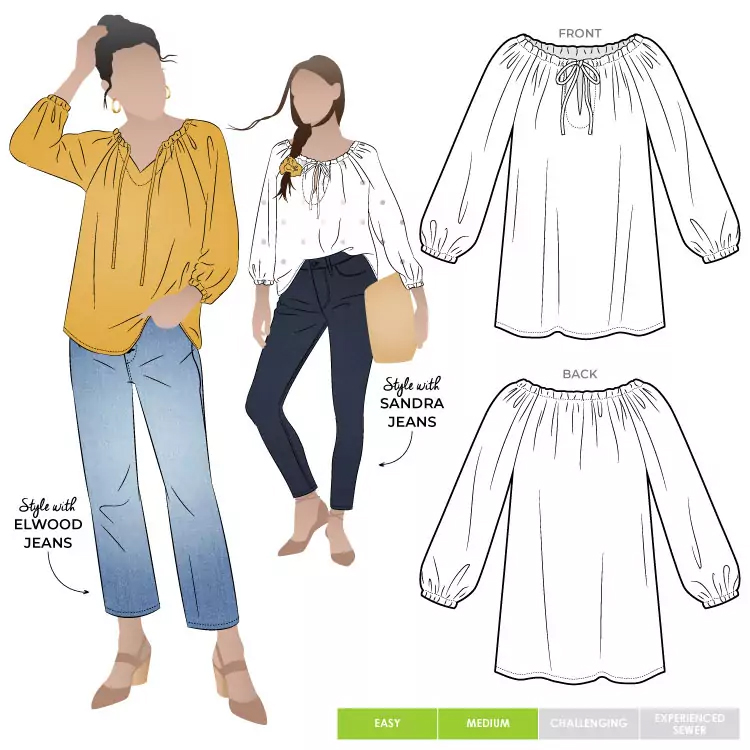
As I did for Gloria’s vyshyvanka, I once again hacked the Style Arc Anita Blouse pattern. The Anita is a well-drafted, classic peasant blouse pattern with raglan sleeves and lots of ease. I knew the Anita Blouse would lend itself well to the modifications I wanted to make. I altered the pattern as following:
- split the front piece down the center into two pieces to accommodate a button placket
- altered the sleeve using the slash and spread method to add more fullness to the balloon (photo illustrated in previous post)
- self- drafted two facings for the button plackets
- frankensteined a mandarin collar from another pattern
- added self-drafted cuffs and a self-fabric bias tape finish to the sleeve vents
- added rouleau loops made from 1″ wide bias strip of main linen in lieu of button holes
Prepping Fabric Pieces for Hand Embroidery

At the cutting out stage, I want to take several steps to prepare the pieces for the embroidery process. These pieces have to live through a lot of extra handling. To minimize any potential fraying, I overlock all of the raw edges on the pieces that I will be hand embroidering. I duplicate any necessary markings and notches using thread tracing method and cotton basting thread, to make sure the markings are lasting.
I cut the water soluble waste canvas into sizes that will accommodate the different motifs I will be embroidering, plus a little extra. These waste canvas pieces are hand basted into position. For this blouse I needed to carefully position the waste canvas on the cuffs and the collar to make sure I wouldn’t be wandering into seam allowance areas with embroidery. I was a little more relaxed in placing the waste canvas for the individual floral motifs. Just making sure they were in a pleasing, well spaced out pattern on the front panels and sleeves.
Executing the Cross Stitch Embroidery
With the waste canvas basted on, I started embroidering. I set a goal to finish at least one floral spray per day. But, as usual, things don’t always go to plan. I found that on some days I exceeded my goal, and on some days I didn’t get any embroidery done at all. So it all kind of balanced out, and in the end, I actually finished with the embroidery a little ahead of schedule.
I used the same embroidery techniques I was taught as a young girl. These are described in detail with video in my previous post regarding Ukrainian Embroidery Techniques:
- embroidering without the aid of a hoop using the sewing method versus the stabbing method
- keeping the embroidery neat both front and back using no-knot starts and stops
- limit thread travel on the backside, and when necessary, weaving the thread through the back stitching

They Are All Unique
Careful examination of my finished floral sprays would reveal that each one is a little different than the next. I did little to no unpicking when a counting or color error was made — and believe me, they were made 🙂 I simply worked around any mistake, and just worked it in. This is easy to do given the organic and sporadic nature of my pattern. I’m not bothered by these “mistakes”, and I think the variations add to the handcrafted quality of the work.

Magic Time!
Now that all of the embroidery is complete, it’s time to remove the waste canvas. Yay!
First, I stripped away all the hand basting holding the waste canvas pieces in place. Then carefully, with a small pair of sharp embroidery scissors, I trimmed away as much of the excess canvas material as possible.
Then I filled the kitchen sink with warm water laced with a few drops of Dawn dish detergent. All the embroidered pieces were thus submerged and soaked for 20 minutes.
After a little agitation and thorough rinsing under warm running water, all were hung to air dry overnight.
The next morning I gave each piece a spritz with a 50/50 vinegar/water solution, and a good steam press. So easy — especially when compared to removing traditional starched waste canvas. Removing traditional waste canvas would have entailed days! I am a water soluble waste canvas convert for sure!!


Sewing it Together
My vyshyvanka blouse is intended as an heirloom piece of clothing, and I chose to take the time to use quality construction and finishing techniques:
- eschewing iron-on interfacing for this project, I used silk organza as a sew-in interfacing at collar, cuffs and placket facings
- french seams at the raglan shoulder seams
- faux flat fell seams at the side and sleeve seams
- honeycomb smocking at neckline (versus standard gathers)
- bias trim finish at sleeve vent
- 2″ long`rouleau loops for buttons inserted in the facing seam
- custom embroidered buttons with fabric shank sewn on with Corticelli silk buttonhole twist
- hand stitched hem with silk thread
- a hand embroidered label


In Every Stitch


Creating this contemporary vyshyvanka blouse has been a journey stitched with memory, meaning, and a deep sense of connection to my Ukrainian heritage, to the women in my family who came before me, and the beautiful women coming up after me.

I am greatly enjoying reading about your process to rediscover your heritage. My heritage includes Polish/Jewish ancestry and I have two granddaughters whose heritage, as well as this, includes Croatian and Polish. You have inspired me to create similar heirlooms for my granddaughters that will remind them of their ancestral origins and their grandmother’s love. While none of the Ukrainian heritage specifically belongs to us, we lived through the same traumas that now lead us to empathise with Ukrainians in their fight for freedom and their unique identity. It is the Central European traditions that speak to us and that will convey meaning in these heirloom blouses. Thank you for producing and documenting and sharing your cultural history, including as you do the small but meaningful importance of every day, where everything has value and is worth remembering and reproducing.